

The Forgotten OT Asset Lifecycle:
Why Tracking Beyond Installation Matters
Every industrial asset has a lifecycle.
Installation is only the beginning.
From that point, assets are validated, used, maintained, relocated, updated and eventually retired. This is what defines OT asset lifecycle management.
Simple in theory. Less consistent in practice.
In many factories, asset tracking is strongest at installation. After that, updates move into spreadsheets, relocations rely on team knowledge, and retirements are not always recorded immediately.
Over time, visibility fades.
So here is the real question:
Do you have complete visibility across your OT asset lifecycle or just at the point of installation?
If the answer is unclear, you are not alone.

What is OT Asset Lifecycle Management?
OT asset lifecycle management is the process of tracking and managing industrial assets from installation through to retirement.
It includes:
- Registration and validation
- Ongoing use and maintenance
- Relocation tracking
- Firmware and configuration updates
- Secure decommissioning
Without full lifecycle tracking, asset visibility becomes fragmented.
What is OT Asset Lifecycle Management?
OT asset lifecycle management is the process of tracking and managing industrial assets from installation through to retirement.
It includes:
- Registration and validation
- Ongoing use and maintenance
- Relocation tracking
- Firmware and configuration updates
- Secure decommissioning
Without full lifecycle tracking, asset visibility becomes fragmented.
What is OT Asset Lifecycle Management Matters?
1. Operational impact
When assets are not tracked across their lifecycle, teams may spend additional time locating equipment or verifying configurations.
This does not directly cause downtime. But it can extend recovery and setup time.
According to Siemens’ The True Cost of Downtime 2022, unplanned downtime costs Fortune Global 500 companies approximately $1.5 trillion annually.
Clear lifecycle tracking supports faster response and improved MTTR.
2. Compliance expectations
The NIS2 Directive (EU Directive 2022/2555) requires organisations to demonstrate ongoing control over their systems.
This includes:
- Accurate asset records
- Traceable updates
- Continuous governance
Lifecycle tracking strengthens compliance by providing a complete, auditable history.
3. Cyber security and asset visibility
The ENISA Threat Landscape 2023 highlights increasing cyber threats to industrial environments.
Visibility gaps remain a challenge.
Assets that are moved, modified or left inactive without tracking may not appear in current records.
OT asset visibility across the lifecycle helps reduce these blind spots.
4. Financial efficiency
Incomplete lifecycle tracking can lead to:
- Inefficient maintenance
- Delayed retirement decisions
- Premature asset replacement
Better lifecycle visibility supports more informed investment decisions.

The Complete OT Lifecycle Explained
Effective industrial asset lifecycle management includes six key stages:
1. Installation
Assets are deployed and registered with key details such as location, configuration and ownership.
2. Validation
Assets are verified to ensure correct configuration and compliance.
3. Use
Ongoing operation includes maintenance logs and performance tracking.
4. Relocation
Assets may move between lines or facilities. Without tracking, visibility is lost.
5. Update
Firmware and configuration changes must be recorded to maintain history.
6. Retirement
Assets are decommissioned and removed securely from records and networks.
Why Traditional Tools Fall Short
Most organisations are aware of these lifecycle stages.
The challenge lies in managing them consistently.
1. Spreadsheets and static systems
Spreadsheets are widely used but limited for OT asset tracking.
They:
- Rely on manual updates
- Lack real-time visibility
- Struggle with multiple users updating simultaneously
Over time, inconsistencies emerge.
2. IT-centric tools
Many tools are designed for IT environments, not industrial settings.
They often overlook:
- Physical asset movement
- Field-based updates
- Offline or distributed environments
This creates gaps in lifecycle tracking.
The result
Lifecycle tracking becomes fragmented.
Installation is clear.
What happens after becomes less visible.
And that is where gaps begin to widen.

How Opteca Enables Complete OT Asset Lifecycle Management
The shift is not about adding complexity.
It is about aligning tools with how work actually happens.
That is where Opteca provides a different approach.
A single, lifecycle-focused platform
Opteca supports all stages of the asset lifecycle within one system.
From installation to retirement, each interaction contributes to a continuous record.
There is no need to switch between tools or reconcile separate data sources.
QR-enabled access in the field
Each asset can be accessed instantly via a QR code.
An engineer on-site can:
- Scan the asset
- View its full history
- Update its current status
This removes the gap between action and documentation.
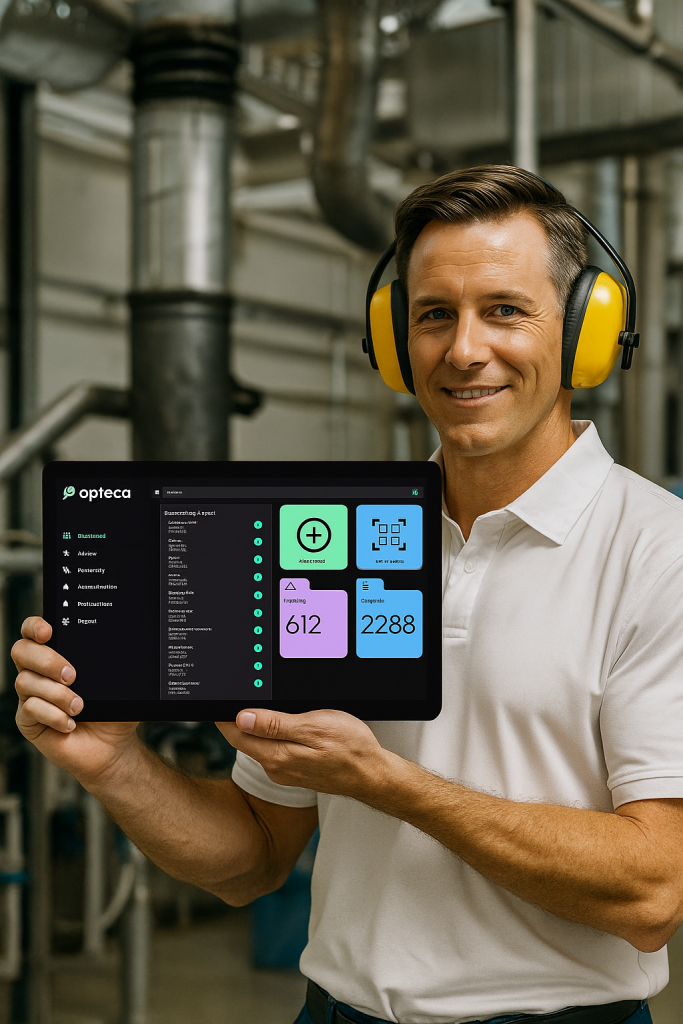
Real-time lifecycle visibility
Dashboards provide a clear view of:
- Asset status across lifecycle stages
- Items pending validation or update
- Recently modified assets
This enables informed decision-making without manual consolidation.
Structured, concurrent updates
Multiple users can update asset records at the same time.
Operators, engineers and maintenance teams contribute as part of their daily work.
Entries are structured, time-stamped and linked to specific assets.
This approach reduces the risk of duplicate entries or overwritten records – challenges often associated with shared spreadsheets.
Timely alerts and prompts
Assets due for validation, update or retirement can be flagged automatically.
This helps teams stay ahead of lifecycle requirements rather than reacting to them.
Practical Benefits of OT Asset Lifecycle Management
When lifecycle tracking becomes continuous, organisations often see measurable improvements.
Better operational clarity
Teams know where assets are, how they are configured and what has changed.
This supports faster decision-making on the plant floor.
Stronger audit readiness
Complete lifecycle histories provide clear, traceable evidence.
Audit preparation becomes simpler and more predictable.
Improved asset utilisation
With better visibility into usage and history, organisations can make more informed decisions about maintenance, upgrades and retirement.
A Hypothetical Scenario
Consider a manufacturing site managing over 2,000 OT assets across multiple production lines.
Before adopting a lifecycle-based approach:
- Asset records were updated periodically
- Relocation tracking was inconsistent
- Audit preparation required significant manual effort
After implementing structured, field-driven lifecycle tracking:
- Asset visibility improved across all stages
- Records were updated continuously during daily operations
- Audit preparation time reduced from weeks to hours
The assets remained the same.
The visibility improved.
And that shift supported more controlled, efficient operations.
From Installation to Insight
In modern industrial environments, OT asset lifecycle management is no longer optional.
Asset management today does not end at installation.
It evolves.
With increasing connectivity, regulatory expectations and operational complexity, lifecycle visibility is becoming essential.
Not as an added layer of work.
But as a way to simplify control.
So consider this:
Are your assets only recorded – or truly managed throughout their lifecycle?
If there are gaps, there is an opportunity to close them.
Leave a Reply