

Asset Validation in OT: From Headache to Habit – How OPTECA Makes It Simple
How many IP-enabled devices are running in your plant right now?
Not roughly.
Not “about right”.
Precisely.
And of those, how many are fully validated, documented and verified in the last six months?
If that question makes you pause, you are not alone.
Industrial environments are more connected than ever. PLCs. Sensors. Drives. HMIs. Industrial PCs. Robots. Remote access gateways. Vision systems. The list keeps growing.
And so does the risk of not having full visibility.
According to the IBM X-Force Threat Intelligence Index 2023, manufacturing was the most targeted industry for cyber-attacks for the third consecutive year. At the same time, Claroty’s State of CPS Security 2023 report found that 75% of organisations report visibility gaps across their industrial environments.
That combination – rising threats and incomplete visibility – is where asset validation becomes critical.
Not as a compliance tick-box.
But as an operational discipline.

Why Validation Matters More Than Ever
1. Operational resilience and MTTR
When a production issue occurs, the clock starts immediately.
Engineers need answers:
- What device is this?
- What firmware is running?
- Who owns it?
- Has it been modified recently?
- What else is it connected to?
If those answers are not readily available, recovery takes longer.
Unvalidated assets do not automatically cause downtime. But incomplete or outdated records can extend Mean Time to Repair (MTTR) because teams first need to establish clarity before they can resolve the issue.
And downtime is expensive.
A Siemens report, The True Cost of Downtime 2022, estimates that unplanned downtime costs Fortune Global 500 companies approximately $1.5 trillion annually. While not every organisation operates at that scale, the principle is universal: the longer recovery takes, the greater the financial and operational impact.
Asset validation reduces uncertainty.
Reduced uncertainty supports faster recovery.
Faster recovery improves MTTR.
It is that simple.
2. Regulatory and compliance pressure
Regulation is also tightening across Europe.
The NIS2 Directive (EU Directive 2022/2555) requires organisations operating essential and important services to implement appropriate risk management measures and maintain demonstrable control over their network and information systems.
In practice, that means:
- Knowing what assets exist
- Understanding how they are configured
- Being able to demonstrate governance and oversight
Auditors are increasingly asking for evidence – not assumptions. Historical validation logs. Ownership records. Update trails.
A static spreadsheet created once a year is unlikely to satisfy that requirement.
Validation needs to be current, traceable and defensible.
More importantly, it needs to demonstrate that asset recording and management are not occasional activities, but continuous operational functions.
Opteca supports this shift by operating as a scheduled system of asset validation – effectively an ongoing audit layer embedded into day-to-day or periodic maintenance routines.
Rather than scrambling to compile evidence ahead of an inspection, organisations can show auditors something far stronger:
a living validation history that proves asset governance is constant, structured and actively maintained.
3. Cyber exposure and shadow assets
Industrial cyber risk is no longer theoretical.
The ENISA Threat Landscape 2023 report highlights continued growth in ransomware and supply chain attacks targeting critical infrastructure.
Many successful attacks exploit what organisations did not know they had – unmanaged remote access tools, legacy devices, forgotten test systems.
Shadow assets create blind spots.
Blind spots increase uncertainty, which in turn can elevate operational and security risk.
Validation does not eliminate cyber threats. But it significantly reduces unknowns.
And in OT, reducing unknowns is a powerful form of risk control.

The Traditional Pain Points
If validation is so important, why is it still treated as a periodic exercise rather than a daily habit?
Because the process itself often works against the people expected to perform it.
Spreadsheets
Most plants start with a spreadsheet.
It feels practical. Accessible. Simple.
But spreadsheets:
- Depend on manual updates
- Are typically maintained by a limited number of people
- Quickly drift out of date
- Provide no real-time visibility
- Offer no structured audit trail
They are records.
They are not validation systems.
Opteca also relies on human interaction but the difference is how and when that interaction happens.
Updates are completed by operators, engineers and maintenance teams as part of their normal day-to-day activities.
Validation does not sit with one person updating a central file after the fact.
It is distributed across the workforce, captured in the moment, and structured within a controlled system.
The manual effort remains.
The friction and fragility do not.
IT-centric tools
Some organisations implement enterprise asset or IT management systems.
These tools can be powerful. But they are often designed for office workflows rather than plant-floor realities.
Field engineers may need to:
- Take notes manually
- Return to a workstation
- Log into a system later
- Re-enter information
That delay introduces friction.
And friction discourages consistency.
Validation becomes something done ahead of audits. Not something embedded into daily operations.
How Opteca Turns Validation into a Daily Habit
The breakthrough is not complexity. It is usability.
Validation needs to happen where the asset lives – on the plant floor.
That is where Opteca changes the equation.
1. Field-ready mobile access
An engineer standing in front of a cabinet can:
- Scan a QR code
- Instantly access the asset record
- Verify configuration details on the spot
- Enter asset information on the spot
No paperwork.
No return to the office.
No delay.
The process aligns with existing maintenance routines.
An engineer standing in front of a cabinet can:
- Scan a QR code
- Verify configuration details on the spot
No paperwork.
No return to the office.
No delay.
The process aligns with existing maintenance routines.
2. Structured, simple updates
On-site, teams can:
- Confirm model and firmware
- Log IP and MAC addresses
- Capture photographs
- Mark status as verified
- Record observations
Each interaction updates the central system.
Over time, these small actions build a robust validation history – one that supports both operational efficiency and audit readiness.
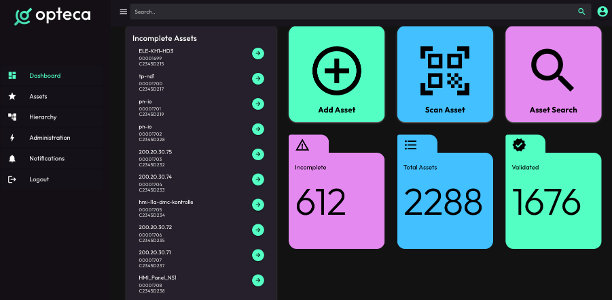
3. Immediate oversight
Management gains clear visibility without chasing reports.
Dashboards show:
- Percentage of validated assets
- Assets pending verification
- Trends over time
- Areas requiring attention
This enables proactive oversight rather than reactive reconciliation.
The Practical Impact
When validation becomes routine, measurable improvements follow.
Faster audits
Validated asset registers and historical logs can be exported quickly.
Preparation time drops.
Confidence increases.
Audit stress reduces.
Improved MTTR
When incidents occur, engineers are not starting from zero.
They work from verified data.
That clarity supports faster diagnosis and recovery – directly influencing MTTR and operational continuity.
Stronger workforce ownership
Perhaps most importantly, validation becomes owned by operations and maintenance teams.
It is no longer an IT bottleneck.
It becomes part of the culture.
And culture is what sustains long-term compliance and resilience.
A Hypothetical Scenario
Consider a mid-sized manufacturing plant operating across three production halls.
Before deploying Opteca:
- Asset validation was conducted twice per year
- Records were spreadsheet-based
- Audit preparation required two weeks of reconciliation
After introducing mobile validation into routine maintenance rounds:
- Validation coverage reached over 90% within three months
- Asset records were updated continuously
- Audit preparation time reduced by approximately 80%
- A NIS2 pre-audit review reported no documentation findings
The infrastructure did not change.
The behaviour did.
And that shift in process supported measurable operational improvement.

From Headache to Habit
The industrial landscape is only becoming more connected.
More devices.
More integration.
More regulation.
Clarity is becoming essential in modern OT environments.
Asset validation should not feel like an annual fire drill. It should feel routine – embedded into daily practice.
So, ask yourself again:
How many IP-enabled assets are operating in your plant today?
And how many are validated with confidence?
If there is uncertainty, there is opportunity.
Leave a Reply